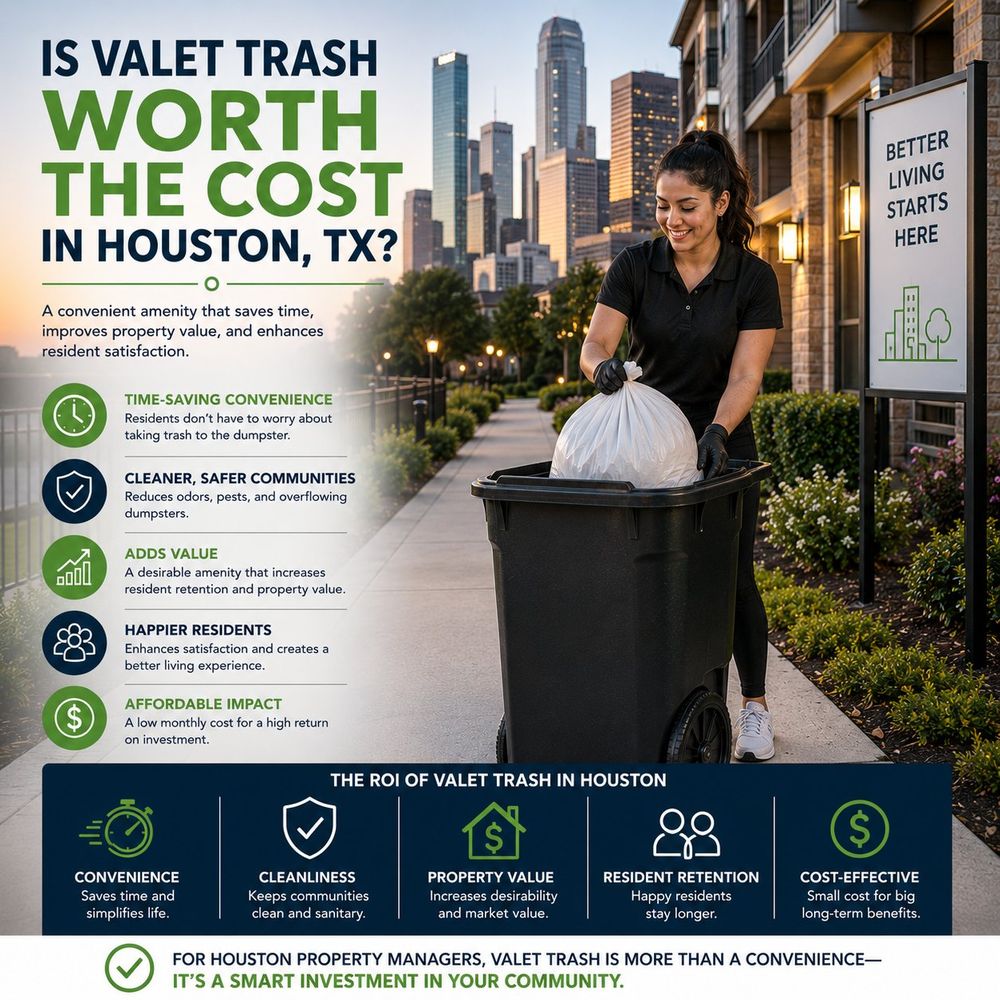
Valet trash service has quietly become one of the most common amenities in Houston multifamily properties, from luxury high-rises in Midtown to garden-style communities in Katy, Sugar Land, and The Woodlands. But with monthly fees showing up on resident ledgers and service contracts adding to operating expenses, owners and renters alike keep asking the same question: is valet trash actually worth the cost?
The short answer is "usually yes, but with caveats." Below, we break down current valet trash pricing in the Houston market, the real benefits for residents and owners, the situations where the service does not pay off, and a simple ROI framework you can apply to your own property.
Is Valet Trash Worth It For Houston Properties?
For most Houston apartment communities with 100 or more units, valet trash is worth the cost. It generates a net positive monthly fee per unit, reduces trash-related work orders and complaints, supports curb appeal, and protects resident retention in a competitive Houston rental market.
The tradeoff is straightforward. Residents pay a small recurring fee (typically $20 to $35 per month) in exchange for doorstep pickup five nights a week. Property owners pay a per-unit service cost to the valet trash vendor and keep the margin in between. When the service is well-run and communicated properly, residents see real convenience, common areas stay cleaner, and ownership earns predictable ancillary revenue.
It is not a fit for every property. Very small communities, properties with weak resident enforcement, or buildings where dumpsters sit just steps from every door may not see enough lift to justify the fee. The rest of this guide will help you figure out which side of that line your community falls on, with Houston-specific pricing and examples.
What Valet Trash Costs In Houston
Valet trash pricing in Houston has two sides: what the property pays the service provider, and what the resident sees on their monthly statement. Both numbers matter, and the gap between them is where the ROI lives.
On the property-manager side, most Houston valet trash vendors charge somewhere between $9 and $14 per occupied unit per month for standard five-night-a-week service. On the resident-facing side, the same service is typically billed at $20 to $35 per unit per month, depending on the market, the comp set, and how the amenity is positioned. That spread is the property's gross margin, and it is the single biggest driver of whether valet trash is worth offering.
Pricing varies based on unit count, service frequency (three nights versus five nights versus seven nights), contract length, and whether the property layers in add-ons like recycling pickup, bulk item removal, or holiday schedule coverage.
Typical Pricing By Property Size
Larger communities almost always get better pricing per unit. Vendors care about route density, and a 300-unit property in the same submarket as a 90-unit property is far more efficient to service.
| Property Size | Property Cost / Unit / Month | Typical Resident Fee |
|---|---|---|
| Small (under 100 units) | $12 – $14 | $22 – $28 |
| Mid-size (100 – 250 units) | $10 – $12 | $25 – $32 |
| Large (250+ units) | $8 – $10 | $28 – $35 |
Small communities (under 100 units)
Property cost typically lands at the top of the range, often $12 to $14 per unit per month, sometimes higher if the property is geographically isolated. Resident fees usually sit at $22 to $28 to keep the amenity competitive in a smaller building.
Mid-size communities (100 to 250 units)
This is the sweet spot for valet trash in Houston. Property costs commonly land at $10 to $12 per unit per month, with resident fees of $25 to $32. Margins here are healthy and the operational lift is manageable.
Large communities (250+ units)
Bulk pricing kicks in. Property costs can drop to $8 to $10 per unit per month for properties with 300 or more units, while resident fees frequently hit $28 to $35. This is where valet trash becomes a meaningful revenue line, not just a convenience.
These figures move with the Houston submarket. Properties inside the Loop and in high-density areas like Galleria, Midtown, and EaDo tend to price residents at the higher end. Suburban communities in Pearland, Pasadena, and Cypress often land slightly lower on the resident side but keep similar margins.
What Affects The Price
Several factors push valet trash pricing up or down beyond simple unit count:
- Service frequency. Five nights a week is the Houston standard. Three-night service costs less but is harder to sell to residents. Seven-night service adds 20% to 30% to the property cost and is rare outside of luxury properties.
- Community layout. Walk-up garden-style properties with long distances between buildings and the compactor cost more to service than wrap or podium buildings with central trash rooms. Stairs, gated walkways, and sprawling site plans all add labor.
- Add-on services. Recycling pickup, glass collection, bulk item removal, and pet waste station maintenance can each add $1 to $3 per unit per month on the property side.
- Contract terms. Three-year contracts almost always price better than one-year deals. Auto-renewal clauses, CPI escalators, and exclusivity provisions all affect the final number.
- Market competition. Houston has more valet trash vendors than most metros its size, which keeps pricing competitive. Surrounding cities like Conroe, League City, and Galveston have thinner vendor coverage, which can push prices up 10% to 15%.
Comparing Houston Valet Trash Quotes?
Skip the cold outreach. The directory connects you with providers actively running routes in your specific city.
Request A QuoteBenefits Of Valet Trash
The cost story only matters if the service actually delivers value. In a competitive Houston rental market where renters compare amenities line by line before signing, valet trash earns its place for three core reasons: convenience, cleanliness, and retention.
Convenience For Residents
The pitch is simple. Residents leave a sealed bag in a provided container outside their door, five evenings a week, and it disappears overnight. No hauling trash down three flights of stairs in the rain. No 100-yard walk to the compactor after a long day. No wrestling with a heavy bag in the parking lot at 11 p.m.
In Houston specifically, the convenience factor is amplified by weather. Summer heat regularly pushes past 95 degrees, hurricane season brings stretches of heavy rain, and humidity makes any outdoor chore feel longer than it is. Doorstep pickup turns a daily annoyance into a non-event, and that is exactly the kind of small-but-constant convenience renters notice and remember.
Busy professionals, families with young kids, and older residents tend to value the service most. For these renters, the time savings alone often justify the fee.
Cleaner Common Areas And Better Curb Appeal
Properties without valet trash deal with predictable problems: overflowing dumpsters on Sundays and Mondays, bags left next to the compactor when it is full, odor complaints in summer, and trash trails between buildings and the dumpster pad.
Valet trash routes pull waste from doors before it accumulates in common areas. Bags go directly into the compactor on the same nightly route, which keeps the area around the compactor cleaner and reduces the windows when overflow can happen. For Houston properties dealing with summer heat and the smell that comes with it, that nightly cycle makes a visible difference.
Cleaner curb appeal supports tours, photo shoots, and resident pride. Prospects forming a first impression at 6 p.m. on a Tuesday will not see bags lined up on stairways, and existing residents will not photograph an overflowing dumpster and post it to the property's review pages.
Retention And Leasing Value
Valet trash is a small amenity, but small amenities compound. When a renter is choosing between two similar Houston properties, the one with doorstep trash pickup, package lockers, and a dog park usually wins. None of those amenities is decisive on its own, and together they shape the perception of "this property takes care of me."
The retention angle matters even more than leasing. Every turn in a Houston apartment community costs ownership somewhere between $1,500 and $4,000 once you factor in make-ready, marketing, and lost rent. If valet trash contributes even fractionally to renewal rates by reducing daily friction, the math gets very favorable very quickly.
When Valet Trash Is Not Worth It
A balanced answer requires being honest about the scenarios where valet trash does not pay off. There are real situations in Houston where the service is the wrong call.
- Very small properties. Communities under 50 units often struggle to make the math work. Vendor pricing is high per unit, route efficiency is low, and the resident fee can feel disproportionate when residents can see the compactor from their front door.
- Properties with weak enforcement. Valet trash only works if residents follow the program: sealed bags, in the provided container, set out during the designated window. Properties that will not issue violations for bags in hallways, trash set out at 8 a.m., or oversized items in containers end up with hallway messes and pest issues, which destroys the perceived value of the service.
- Strong existing trash infrastructure. Properties with multiple well-placed compactors, short walking distances, and a layout that makes self-haul genuinely easy may see less lift from adding valet service. The amenity still adds value, but the ROI is thinner.
- Low resident buy-in. In markets or submarkets where renters expect lower fees and fewer add-ons, mandatory valet trash fees can create friction during renewals and tour conversion.
Cost vs. Resident Perception
The single biggest failure mode for valet trash is not the service itself, it is how residents perceive the fee.
When residents see a $30 line item on their statement and do not understand what they are paying for, the amenity becomes a target during renewal conversations. They start asking why they cannot just walk to the dumpster. They start comparing the fee to the property down the street that "does not charge for that." That is a positioning problem, not a service problem.
Properties that succeed with valet trash treat it like any other amenity. They mention it on tours, include it in lease conversations, explain the value during move-in, and remind residents of the convenience throughout the year. Properties that bury it as a line item without context tend to invite the objections.
Valet Trash ROI For Houston Multifamily Properties
For owners and operators, the financial case for valet trash is built on three pieces: monthly margin per unit, reduced trash-related operating issues, and indirect retention value.
The direct revenue math is the easiest to see. If you pay your vendor $10 per occupied unit per month and charge residents $28 per occupied unit per month, your gross margin is $18 per occupied unit per month. At 95% occupancy on a 200-unit property, that is $3,420 in monthly margin, or roughly $41,000 per year in ancillary revenue before any indirect benefits.
The indirect benefits are harder to model but real. Fewer overflow incidents mean fewer maintenance hours redirected to cleanup. Less pest pressure around dumpsters reduces extermination spend. Better curb appeal supports tour conversion. Lower daily friction supports renewal rates.
Sample ROI Scenario
Here is a realistic Houston example. Assume a 220-unit garden-style property in Pearland with 94% average occupancy:
220-Unit Pearland Property · 94% Occupancy
- Property cost (220 × $10)$2,200 / month
- Resident revenue (220 × 0.94 × $28)$5,790 / month
- Monthly margin$3,590 / month
- Annual margin$43,080 / year
That is the direct number. Now layer in the soft benefits. If improved curb appeal and reduced daily friction contributes to retaining even three additional residents per year who would otherwise have moved out, and average turn cost is $2,500, that is another $7,500 in avoided turn costs. Total annual impact lands closer to $50,000 on a property this size, with very little operational lift required from the on-site team.
Run the same math on a 90-unit property and the picture changes. Higher per-unit vendor cost, smaller occupancy base, and the margin may only support $12,000 to $15,000 per year in direct revenue. Still positive, but a smaller cushion if anything goes wrong with execution.
Houston And Nearby City Market Factors
Houston's multifamily market is one of the largest and most active in the country, with well over 700,000 apartment units in the metro and steady absorption across submarkets. That scale matters for valet trash in two ways: vendor density is high, and renter expectations are well-established.
Inside the Loop and in core submarkets like the Galleria, Midtown, Heights, EaDo, and the Energy Corridor, valet trash is essentially table stakes for any property at the Class A or upper Class B level. Renters expect it, and properties that do not offer it have to compete on price or other amenities to make up the gap.
In surrounding cities, the picture varies:
- Sugar Land and Katy: Strong adoption, especially in newer Class A properties. Renters here skew toward families and dual-income professionals who place a high value on convenience.
- The Woodlands: Very high penetration. Master-planned community standards and a renter base used to premium service make valet trash close to mandatory at competitive properties.
- Pasadena and Pearland: Mid-tier adoption. Cost-sensitivity is higher, so resident fees tend to land at the lower end of the Houston range.
- Conroe, League City, and outer ring suburbs: Lighter coverage and fewer vendors, which can push pricing up but also creates differentiation opportunities for properties that adopt early.
Across the 150-mile radius around Houston, the general rule holds: the higher the density and the more competitive the submarket, the higher the resident expectation for valet trash service.
How To Decide If It Fits Your Property
If you are weighing valet trash for your community, a short evaluation framework cuts through most of the noise. Work through these questions before signing any contract:
- How many units do you operate, and what is your stable occupancy? Below 75 units, scrutinize the math carefully. Above 150 units, the case is usually strong.
- What does your comp set offer? If three of your five closest competitors have valet trash and you do not, the amenity gap is hurting you on tours. If none of them offer it, you have either a differentiation opportunity or a market that is not ready.
- What is your current trash situation? Frequent overflow, odor complaints, or pest issues are signals that valet trash will pay for itself in operational relief.
- What is your resident demographic? Properties with busy professionals, families, and older renters get more value from the convenience than properties leasing primarily to students or short-term renters.
- Can your team enforce the program? If you cannot or will not issue violations for non-compliance, valet trash will not work, regardless of the vendor.
- What is your budget sensitivity on the resident side? If your rents are already pushing the top of the submarket, an added fee can be the straw that breaks renewals. If you have headroom, the fee absorbs more easily.
If you answer most of these in favor of the service, it is almost certainly worth piloting. If multiple answers point the other way, look at smaller alternatives like improved dumpster maintenance, additional compactor pickups, or signage before committing to a full valet contract.
Final Recommendation
For most Houston multifamily properties with 100 or more units, valet trash is worth the cost. It generates positive monthly margin, reduces trash-related operating issues, supports curb appeal, and matches the expectations of renters in a competitive market.
The properties that benefit most are mid-size and large communities in core Houston submarkets and high-demand suburbs like The Woodlands, Sugar Land, and Katy, where renters already expect the amenity and where vendor pricing is most efficient. The case is weaker for very small properties, communities with poor enforcement, or buildings with already-excellent trash infrastructure.
If your property fits the profile, treat valet trash as an amenity that needs to be sold and managed, not a passive line item. Communicate the value to residents at every touchpoint, hold the program to a standard, and the service will deliver convenience, cleaner common areas, and meaningful ancillary revenue for years.