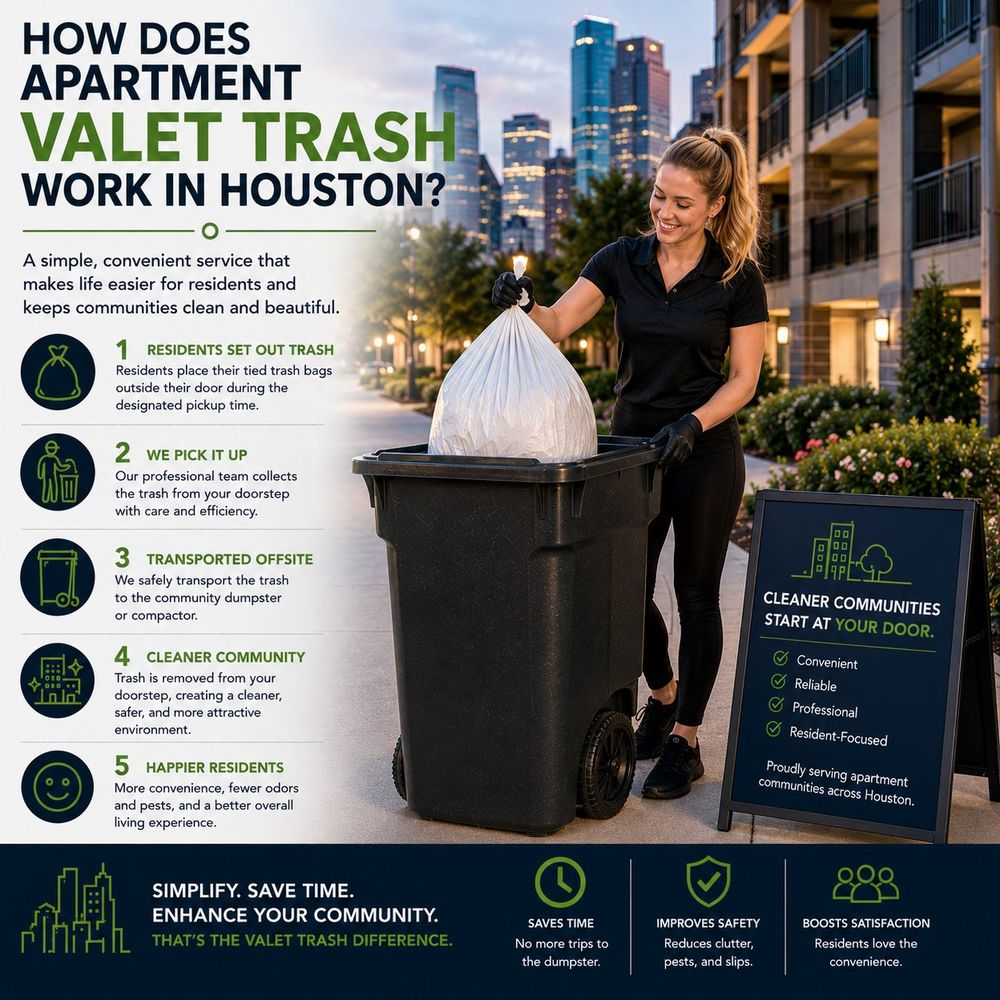
If you have toured a Houston apartment in the past few years, you have probably seen a small bin sitting outside a few unit doors in the evening. That is valet trash in action, and it has become one of the most common amenities in Houston multifamily properties. This guide walks through exactly how the service works, what residents need to do, what to expect on pickup nights, and why so many Houston apartments now offer it.
How Apartment Valet Trash Works In Houston Communities
In plain language, valet trash is doorstep waste collection for apartment residents. Instead of carrying trash bags down to a dumpster or compactor, residents place tied bags in a provided container right outside their front door during a set evening window. A uniformed valet trash team makes rounds through the property, collects every bag, and transports the waste directly to the community dumpster or compactor for final disposal.
The service runs on a fixed schedule, typically five evenings a week, and operates across nearly every type of Houston multifamily property — from urban mid-rises in the Heights and Midtown to garden-style communities in Katy, Sugar Land, Pearland, and The Woodlands. For renters dealing with Houston summer heat, long workdays, and the daily friction of apartment living, having someone else handle the trash haul is one of those small conveniences that quickly becomes hard to live without.
What Is Apartment Valet Trash?
Apartment valet trash is a door-to-door waste collection service offered as an amenity by multifamily properties. A third-party vendor (or in some cases, an in-house team) handles the nightly route, picks up tied bags from each participating unit, and disposes of the waste in the property's central trash system.
It is important to understand what valet trash is not. It does not replace the city or municipal trash service that handles the property's compactor or dumpster. The compactor still gets hauled away on its normal schedule by a commercial waste hauler. Valet trash sits in between the resident's front door and that compactor, eliminating the step where the resident has to make the trip themselves.
This positions valet trash as a multifamily amenity rather than a utility. It is bundled into the lease at most Houston properties as a mandatory service, similar to how trash, pest control, or common-area maintenance fees appear on monthly statements. The convenience is the product.
How The Service Works Step By Step
The full valet trash process is simple from the resident's side and tightly choreographed from the operator's side. Here is what happens on a typical service night.
Residents Bag And Set Out Trash
Each participating resident receives a valet trash container at move-in, usually a sturdy plastic bin with a lid. On scheduled service nights, the resident places household trash inside a securely tied bag (most properties require 13-gallon kitchen bags or similar), sets the bag inside the provided container, and puts the container just outside their unit door during the designated service window, commonly between 6:00 p.m. and 8:00 p.m.
The rules around timing exist for a reason. Trash set out too early creates odor and pest issues in hallways and breezeways. Trash set out after the pickup window may sit overnight or get missed entirely. Most Houston properties enforce the time window through lease addendums and may issue violations for repeat offenders.
Valet Staff Collects The Bags
Once the service window opens, the valet trash crew begins their route. Crews are typically uniformed, often carrying handheld scanners, dollies, or pushcarts, and may use branded vehicles on the property. They move building by building, floor by floor, collecting every tied bag from every participating unit.
Routes are designed for efficiency. A well-run vendor will hit every door in a 200-unit property within two to three hours. If a unit's bin is empty or missing, the crew moves on. If a bag does not meet the rules (untied, oversized, or contains prohibited items), most operators leave a courtesy tag explaining the issue rather than taking the bag.
Trash Is Transported To The Dumpster
Collected bags go directly to the property's compactor or dumpster. The crew loads everything in, secures the area, and finishes the route. By the time most residents are in bed, the trash is gone and the bins are sitting empty outside the doors, ready to be brought back inside the next morning.
This nightly cycle is what keeps Houston apartment hallways, breezeways, and dumpster pads cleaner than they would be otherwise. Instead of trash accumulating around the compactor over the course of a weekend, it gets consolidated and disposed of in a single nightly sweep.
Need Valet Trash At Your Property?
Get matched with vetted Houston valet trash providers serving your city. Quotes typically arrive within 48 hours.
Request A QuoteRules Residents Need To Follow
Valet trash works because residents follow a small set of rules consistently. Most lease addendums for the service spell these out clearly, and properties enforce them through warnings and fees for repeat violations.
✓ What Can Be Set Out
- General household waste, securely tied in a leak-proof bag
- Food waste (double-bag in Houston summers to reduce odor)
- Paper, packaging, and non-recyclable plastics
- Personal care waste
- Recyclables (only on add-on recycling nights, separately marked)
✗ What Cannot Be Set Out
- Loose trash that is not bagged
- Sharp objects like broken glass or razors
- Bulky items: furniture, mattresses, electronics, appliances
- Hazardous materials: paint, motor oil, gasoline, batteries
- Liquids, pet waste in liquid form
- Medical waste, needles, prescription drugs
- Construction debris from DIY projects
Most properties handle bulky items separately, either through a quarterly bulk pickup service or by directing residents to dispose of large items themselves. Houston also offers heavy trash pickup through municipal services in some areas, which residents can use independently.
How Often Valet Trash Is Picked Up
The Houston standard for valet trash is five nights a week, Sunday through Thursday. This schedule lines up with how households generate trash, leaves Friday and Saturday nights for crew rest and route flexibility, and keeps the compactor cycle predictable for the property's waste hauler.
Some properties run different schedules:
- Four nights a week is occasionally used in smaller or lower-budget properties to reduce vendor costs.
- Three nights a week is rare but appears in some value-tier communities.
- Six or seven nights a week is offered at some luxury properties in submarkets like the Galleria, Memorial, and downtown Houston, where premium amenities are part of the rent positioning.
Holidays usually shift the schedule. Most Houston vendors observe Thanksgiving, Christmas, and New Year's Day, with adjusted pickups on the surrounding nights. Properties typically post the holiday schedule in advance through email or community apps. For the full 2026 holiday breakdown, see our Houston valet trash holiday schedule guide.
Benefits For Houston Apartments
Valet trash has become standard at Houston apartments for a reason. The benefits land on three levels: the resident's daily experience, the property's appearance, and the building's long-term performance as a leased asset.
Convenience For Residents
The convenience case is the easy one. Apartment trash is one of those small chores that takes more effort than it should — finding the bag, the keys, shoes, navigating stairs or elevators, walking across a parking lot, sometimes in 95-degree Houston heat or a thunderstorm. Multiply that by two or three trips a week and the friction adds up fast.
Doorstep pickup eliminates that whole sequence. Tie the bag, step outside, set it down, close the door. For residents working long hours, raising young kids, or simply preferring not to navigate a parking lot at night, the time and effort saved is real and noticeable.
Cleaner Property Appearance
Valet trash also keeps the property cleaner in ways residents see every day. Without the service, dumpster areas tend to overflow on Sundays and Mondays. Bags pile up outside the gate when the compactor is full. Residents leave trash next to the door of a closed trash room. Bags break open in the parking lot, and the wind carries debris across the property.
With valet trash, waste moves from doors to the compactor on the same nightly cycle. Common areas stay cleaner. Pest pressure drops. Odor — a real factor in Houston's summer humidity — gets controlled. The property looks better on tours, in photos, and to existing residents day to day.
Leasing And Retention Value
Cleaner properties lease better, and convenient amenities support retention. Valet trash is rarely the single reason a renter signs or renews a lease, but it is often part of the package that tips a decision. When a Houston renter is comparing two similar properties and one offers doorstep trash pickup as a standard amenity, that small detail registers.
On the renewal side, daily friction is the enemy of retention. Every small inconvenience a resident experiences contributes to the eventual decision to move. Removing the trash chore from that list, even if residents stop consciously thinking about it after a few months, helps protect renewal rates.
How Much Apartment Valet Trash Costs
For residents, valet trash is almost always billed as a separate monthly amenity fee. In Houston, that fee typically lands between $20 and $35 per month, depending on the property class, submarket, and service frequency. Some properties bundle the fee into a broader "amenity package" line item alongside pest control, technology fees, or community maintenance.
The fee is generally mandatory and tied to the lease. Residents do not opt in and out month to month, and most properties do not offer an opt-out option. The amenity is treated like any other building-wide service, with the cost spread across every unit regardless of how often a given resident uses it.
For property owners, the cost is on the other side of the same transaction. Vendors typically charge the property $9 to $14 per occupied unit per month, with the spread between vendor cost and resident fee becoming property revenue. For most Houston multifamily owners, this turns valet trash into a small but steady ancillary income stream while also delivering a real amenity to residents.
If you are a renter evaluating a Houston apartment, the valet trash fee is worth checking against the rest of the property's amenity package. A property charging $30 a month for valet trash is asking for $360 a year, so it is reasonable to know what you are getting in return.
Frequently Asked Questions
How does apartment valet trash work?
What time do they pick up trash?
Do residents have to separate trash?
Is valet trash the same as regular trash pickup?
What happens if a resident misses pickup?
Can residents opt out of paying for valet trash?
What if a bag breaks or leaks during pickup?
Final Takeaway
Apartment valet trash is a simple service with a single goal: get household waste from the resident's door to the property's compactor without the resident having to make the trip. Residents bag their trash, set it out during the evening service window, and a uniformed crew handles the rest five nights a week.
For Houston multifamily communities, the service works best when residents follow the rules consistently — tied bags, correct timing, no prohibited items — and when the property positions valet trash as the convenience amenity it is rather than as a hidden fee. When both sides hold up their end, the result is cleaner common areas, fewer trash-related headaches, and one less chore on every resident's weekly list.